Maybe it's the time change and the whole darkness-at-five-thirty-p.m. thing. Maybe it was our recent trip to Tahoe, when I woke up in the middle of the night enveloped in darkness--I couldn't tell whether my eyelids were open or closed--and felt utterly calm. Maybe I've developed some modern-day proto-vampiric ailment, exacerbated by staring at glowing screens for the majority of my waking hours. (God, that's insane.)
At any rate, I seem to have become deeply averse to artificial light, especially the uniform lighting one finds in office buildings and to some extent on our living-room ceiling. (My husband is very fond of this light and thinks it's sun-like, whereas I find it sickening. Light must be a personal thing to some extent.) I posted this TED talk awhile ago about uniform lighting in offices. We're not wired, so to speak, to handle it. We need shadows in the sea of light, and office design should take that into account.
Also there's a street light outside our bedroom window that nothing short of blackout curtains can snuff out. I suppose I could wear one of those masks that you used to
see on neurasthenic starlets in the 50s, except that is a
recipe for getting my face clawed by a cat in the middle of the night. On a larger scale, light pollution is a huge problem for astronomers, nocturnal animals, crime fighting (really bright lights create darker shadows that are easier to hide in), and, I would argue, life in general. The International Dark Sky Association is doing something about that--and homeowners can, too.
Now, if I can just get through the next four months of standard time...
Showing posts with label extremely amateur astronomy. Show all posts
Showing posts with label extremely amateur astronomy. Show all posts
Tuesday, November 08, 2011


Thursday, June 16, 2011
What's a mystery?
While I'm on the subject of mystery, which I have been a lot lately, even though it may not technically be a "subject" as such because we don't, by definition, know what it is...here's a perspective from Leonard Susskind:
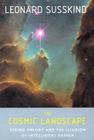
As Susskind's book is called The Cosmic Landscape: String Theory and the Illusion of Intelligent Design, we can be sure that for him (as for me), the answer "[A] god did it" is neither helpful nor interesting. The book, which I am just now starting to read, promises to untangle the seemingly simple (and seemingly wrong) "anthropic principle." I thought I had finally understood this thing awhile ago, but now guess I don't.
Anyway, it does seem worth considering what we really mean when we use the term "mystery." By this definition, a murder mystery really isn't one. It's a...oh, hell, Rumsfeld is a prophet after all..."known unknown."
Now, once more into the cosmological breach.
Shop Indie Bookstores
[I]n the past few years the science sections of newspapers have been reporting that cosmologists are mystified by two astonishing "dark" discoveries. The first is that 90 percent of the matter in the universe is made of some shadowy, mysterious substance called dark matter. The other is that 70 percent of the energy in the universe is composed of an even more ghostly mysterious stuff called dark energy. The words mystery, mysterious, and mystified get a very thorough workout in these articles.Susskind goes on: "The real mystery raised by modern cosmology concerns a silent 'elephant in the room,' an elephant, I might add, that has been a huge embarrassment to physicists: why is it that the universe has all of the appearances of having been specially designed so that life forms like us can exist?"
I have to admit I find neither discovery all that mysterious. To me, the word mystery conveys something that completely eludes rational explanation. The discoveries of dark matter and energy were surprises but not mysteries. Elementary-particle physicists (I am one of them) have always known that their theories were incomplete and that many particles remain to be discovered. The tradition of postulating new, hard-to-detect particles began when Wolfgang Pauli correctly guessed that one form of radioactivity involved an almost invisible particle called the neutrino. Dark matter is not made of neutrinos, but by now physicists have postulated plenty of particles that could easily form the invisible stuff. There is no mystery there--only the difficulties of identifying and detecting those particles.
As Susskind's book is called The Cosmic Landscape: String Theory and the Illusion of Intelligent Design, we can be sure that for him (as for me), the answer "[A] god did it" is neither helpful nor interesting. The book, which I am just now starting to read, promises to untangle the seemingly simple (and seemingly wrong) "anthropic principle." I thought I had finally understood this thing awhile ago, but now guess I don't.
Anyway, it does seem worth considering what we really mean when we use the term "mystery." By this definition, a murder mystery really isn't one. It's a...oh, hell, Rumsfeld is a prophet after all..."known unknown."
Now, once more into the cosmological breach.
Shop Indie Bookstores
Wednesday, May 11, 2011
Space colony art from the 1970s
Commissioned by NASA.
I love these for the same reason I love the NASA logo itself, the one known as "The Meatball." It's the goofy more-is-more graphic optimism of the early space age. (I don't love the alternative logo, known as "The Worm," which has fortunately been retired.)
Of course I'm biased, since my dad worked for NASA. He was at the research center now known as Glenn, formerly Lewis. They used to have "For the Benefit of All Mankind" spelled out in begonias in front of the building.
I love these for the same reason I love the NASA logo itself, the one known as "The Meatball." It's the goofy more-is-more graphic optimism of the early space age. (I don't love the alternative logo, known as "The Worm," which has fortunately been retired.)
Of course I'm biased, since my dad worked for NASA. He was at the research center now known as Glenn, formerly Lewis. They used to have "For the Benefit of All Mankind" spelled out in begonias in front of the building.
Thursday, April 07, 2011
Wind
Yesterday was windy.
Years ago I read a wonderful book called Wind: How the Flow of Air Has Shaped Life, Myth, and the Land by Jan DeBlieu. Naturally I can't find my copy now, but from the Amazon review: "Jan DeBlieu lives on North Carolina's Outer Banks, where 'wind is culture and heritage... Wind toughens us, moves mountains of sand as we watch, makes it difficult to sleepwalk through life.'" At one point, I remember, she says that she feels strange in places that aren't windy like the Outer Banks--not just breezy, but what many would probably call blustery.
I thought of this yesterday, watching the giant redwood at the top of a hill in our neighborhood swirling its branches like some multi-fronded sea creature. My life is largely a still affair, with lots of sitting at desks and staring at words, which may create imagined movements in my head but don't engage in a whole lot of activity on their own. I sit in cars or planes and watch the world pass alongside or beneath me. I am not buffeted, except by psychological currents. In other words, I tend to think of wind as something wrong--as in, it was a beautiful day, but windy.
Wind is strange to me. The air, which normally I just walk through and don't notice, is coming after me, insisting I feel and respond to its presence, affecting the way I move. But why should this be bad? Sure, no one wants to get hit with a trash can lid or a falling tree limb while out on one's daily stroll, but apart from certain hazards, wind's strangeness--for the suburban knowledge-worker, anyway--is psychological. It's a reminder that things are changing all the time. And not just changing all around us, but within us and through us. We're one of those things the wind blows around.
Since I've been immersed in cosmology books lately, the wind also reminds me that we are always in motion, whether we feel it or not. The earth is turning and revolving around the sun; we (the earth, the sun, our solar system) are riding roller-coaster like around the galaxy; we (now expanded to include our galaxy and its compatriots) are shooting along to who-knows-where on the constantly expanding fabric of space-time. That's relativity for you.
I'm not as anchored as I think. Or, rather, I must think of being anchored differently.
Years ago I read a wonderful book called Wind: How the Flow of Air Has Shaped Life, Myth, and the Land by Jan DeBlieu. Naturally I can't find my copy now, but from the Amazon review: "Jan DeBlieu lives on North Carolina's Outer Banks, where 'wind is culture and heritage... Wind toughens us, moves mountains of sand as we watch, makes it difficult to sleepwalk through life.'" At one point, I remember, she says that she feels strange in places that aren't windy like the Outer Banks--not just breezy, but what many would probably call blustery.
I thought of this yesterday, watching the giant redwood at the top of a hill in our neighborhood swirling its branches like some multi-fronded sea creature. My life is largely a still affair, with lots of sitting at desks and staring at words, which may create imagined movements in my head but don't engage in a whole lot of activity on their own. I sit in cars or planes and watch the world pass alongside or beneath me. I am not buffeted, except by psychological currents. In other words, I tend to think of wind as something wrong--as in, it was a beautiful day, but windy.
Wind is strange to me. The air, which normally I just walk through and don't notice, is coming after me, insisting I feel and respond to its presence, affecting the way I move. But why should this be bad? Sure, no one wants to get hit with a trash can lid or a falling tree limb while out on one's daily stroll, but apart from certain hazards, wind's strangeness--for the suburban knowledge-worker, anyway--is psychological. It's a reminder that things are changing all the time. And not just changing all around us, but within us and through us. We're one of those things the wind blows around.
Since I've been immersed in cosmology books lately, the wind also reminds me that we are always in motion, whether we feel it or not. The earth is turning and revolving around the sun; we (the earth, the sun, our solar system) are riding roller-coaster like around the galaxy; we (now expanded to include our galaxy and its compatriots) are shooting along to who-knows-where on the constantly expanding fabric of space-time. That's relativity for you.
I'm not as anchored as I think. Or, rather, I must think of being anchored differently.
Wednesday, March 09, 2011
$125 well spent
Last year, we bought a California State Parks Frequent Visitor pass from the State Parks Foundation. From a direct-mail solicitation, no less. For $125, we got a hang-tag for the car, a subscription to Sunset Magazine, a detailed map, and a remarkably well-written guidebook to all the parks.
I know what you're thinking. Trev and Ann in matching visors and fanny packs, squeezing their Winnebago past bicyclists on Highway One. Or maybe tearing up once-pristine deserts with their OHVs. Not so! Now, I might like to get a smallish RV one day, truth be told. I believe our days of curling up on the hard, lumpy ground while re-breathing our own carbon dioxide inside a tiny tent are behind us. But visors, fanny packs, and OHVs are right out!
My larger point here is that I have become a huge fan of the state parks. Until last year, they were invisible to us. We did not want to pay $10 to check out what was perhaps just a port-a-potty and a dusty trail--so we always drove by. Now we go in. And we have discovered wonders.
For example, the unassuming-looking Sugarloaf Ridge State Park in Sonoma offers some lovely hikes, and contains the Robert Ferguson Observatory, which is open to the public for day- and night-time observing programs. There are three pretty day-use areas tucked inside Point Reyes National Seashore. Your hang-tag gets you into Point Lobos and any number of beaches all along the California coast. There are literally hundreds more options. And not to put too fine a point on it, a whole new world of accessible bathrooms on Highway One has been opened to us.
For us, the hang-tag paid for itself in a couple of months. So, Californians--please consider supporting your embattled but wonderful state parks. We are definitely renewing.
I know what you're thinking. Trev and Ann in matching visors and fanny packs, squeezing their Winnebago past bicyclists on Highway One. Or maybe tearing up once-pristine deserts with their OHVs. Not so! Now, I might like to get a smallish RV one day, truth be told. I believe our days of curling up on the hard, lumpy ground while re-breathing our own carbon dioxide inside a tiny tent are behind us. But visors, fanny packs, and OHVs are right out!
My larger point here is that I have become a huge fan of the state parks. Until last year, they were invisible to us. We did not want to pay $10 to check out what was perhaps just a port-a-potty and a dusty trail--so we always drove by. Now we go in. And we have discovered wonders.
For example, the unassuming-looking Sugarloaf Ridge State Park in Sonoma offers some lovely hikes, and contains the Robert Ferguson Observatory, which is open to the public for day- and night-time observing programs. There are three pretty day-use areas tucked inside Point Reyes National Seashore. Your hang-tag gets you into Point Lobos and any number of beaches all along the California coast. There are literally hundreds more options. And not to put too fine a point on it, a whole new world of accessible bathrooms on Highway One has been opened to us.
For us, the hang-tag paid for itself in a couple of months. So, Californians--please consider supporting your embattled but wonderful state parks. We are definitely renewing.
Wednesday, December 01, 2010
My physics fantasy
I want to be a physicist! Physics is so cool! Why am I not a physicist?
Oh, yeah. For two reasons.
So I've always gobbled up books and TV programs about physics and astronomy in particular. In a way, I can't understand why anyone thinks of anything else: this is what the universe is made of. Where it came from. What it is. Why would a person spend their time, I don't know, writing stories and fucking around on the Internet when there is physics??
My favorite popular physics writer, as of about three weeks ago, is Brian Greene. Greene as a writer is a recent discovery. I was not a huge fan of the TV version of The Elegant Universe. Now, it's not awful. There are far, far worse things on television, even on PBS. But it seemed to be aiming a little too hard for the attention-impaired brains of adolescents. Lots of CGI thingies zipping and zooming around, and--worst of all--every scientist interviewed appears in front of a strange assortment of glowing, blinking panels, which seems to suggest that what they're saying is too boring just to, you know, listen to, so you must instead be flashed and strobed to the brink of epilepsy. If you are looking for the successor to Cosmos as the awesomest intro to the universe ever, I recommend Brian Cox's shows--the recent Wonders of the Solar System, and a couple of earlier Horizon shows, both from the BBC. Cox tends to eschew CGI and create models using rocks and lines drawn in sand, which is both more charming and more effective. (Of the physicist-Brians with one-syllable last names, we must mention in passing Brian May, who, like Cox, is a [former] rock star.)
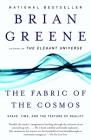
But back to Greene. I just finished reading The Fabric of the Cosmos, and in terms of explaining really complex stuff, really clearly and engagingly, this blows away everything. Sorry, S. Hawking et al! I now *get* why nothing can travel faster than light speed, why time slows down when you travel close to that speed, and a whole bunch of other stuff that I've heard before but had to just accept, because there was no explanation forthcoming. Greene's particular gift is for anticipating exactly what the non-expert reader will be wondering about after an initial explanation, and then filling in the gaps with really effective analogies (though his fondness for The Simpsons is maybe a bit too cute).
I'm almost done raving, but I'll just say that somehow I came upon this book at exactly the right moment for my new novel. I wanted to say some things about time and order and uncertainty, and this book just poured itself into all the gaps. I'm now making my main character a physicist--though a troubled one, of course.
Shop Indie Bookstores
Oh, yeah. For two reasons.
- One: I was always very, very nervous around numbers. Also symbols, like sigmas and such. I took calculus in high school and again in college, and did OK, but the very thought of those classes (particularly the college one) causes my esophagus to seize up. Actually a secondary fantasy of mine is to take calculus again but in some setting where there are no tests. Or no-pressure tests. Like, I would take a test if I knew that if I screwed it up I could take it again till I got it right, because isn't the point, really, in the great scheme of things, to learn math, not to be made to feel like a moron who will never understand anything just because you didn't catch on the first time?
- Two: I forget what two was.
So I've always gobbled up books and TV programs about physics and astronomy in particular. In a way, I can't understand why anyone thinks of anything else: this is what the universe is made of. Where it came from. What it is. Why would a person spend their time, I don't know, writing stories and fucking around on the Internet when there is physics??
My favorite popular physics writer, as of about three weeks ago, is Brian Greene. Greene as a writer is a recent discovery. I was not a huge fan of the TV version of The Elegant Universe. Now, it's not awful. There are far, far worse things on television, even on PBS. But it seemed to be aiming a little too hard for the attention-impaired brains of adolescents. Lots of CGI thingies zipping and zooming around, and--worst of all--every scientist interviewed appears in front of a strange assortment of glowing, blinking panels, which seems to suggest that what they're saying is too boring just to, you know, listen to, so you must instead be flashed and strobed to the brink of epilepsy. If you are looking for the successor to Cosmos as the awesomest intro to the universe ever, I recommend Brian Cox's shows--the recent Wonders of the Solar System, and a couple of earlier Horizon shows, both from the BBC. Cox tends to eschew CGI and create models using rocks and lines drawn in sand, which is both more charming and more effective. (Of the physicist-Brians with one-syllable last names, we must mention in passing Brian May, who, like Cox, is a [former] rock star.)
But back to Greene. I just finished reading The Fabric of the Cosmos, and in terms of explaining really complex stuff, really clearly and engagingly, this blows away everything. Sorry, S. Hawking et al! I now *get* why nothing can travel faster than light speed, why time slows down when you travel close to that speed, and a whole bunch of other stuff that I've heard before but had to just accept, because there was no explanation forthcoming. Greene's particular gift is for anticipating exactly what the non-expert reader will be wondering about after an initial explanation, and then filling in the gaps with really effective analogies (though his fondness for The Simpsons is maybe a bit too cute).
I'm almost done raving, but I'll just say that somehow I came upon this book at exactly the right moment for my new novel. I wanted to say some things about time and order and uncertainty, and this book just poured itself into all the gaps. I'm now making my main character a physicist--though a troubled one, of course.
Shop Indie Bookstores
Friday, October 08, 2010
30th Anniversary (+ 1 week) of Cosmos
OK, so apparently the official 30th anniversary of Cosmos was last week. But think of it...thirty years! I am re-watching the whole series to celebrate.
To my mind there has never been another series like this, weaving all branches of science together with history, culture, beautiful scenery, and great writing, all orchestrated by an intellectual/charismatic/goofball host in a red turtleneck. To think that back then, Sagan was already warning us about global warming (more often called "the greenhouse effect")--in fact, his studies of the atmosphere of Venus helped lay the groundwork for understanding the whole concept. Of course the more immediate worry was nuclear war and the possibly resulting nuclear winter, another idea drawn from studies of Venus. The series's ultimate purpose really was to SAVE THE WORLD by showing us everything we had to lose.
For me, the show continues to inspire a form of secular awe that I imagine other people get when attending church or reading sacred texts. Who are the scientists, artists, and intellectuals who can inspire us this way today? Will pseudo-intellectual religious demagogues continue to fill this vacuum?
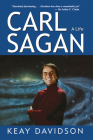
Yes, I know Sagan was a jerk in his off-hours. I know the set of Cosmos was an unpleasant place to be much of the time (sparkling ocean/Mediterranean Sea notwithstanding). The book below tells some of those stories. Such are the contradictions we must often hold in our minds in the presence of masterpieces.
Anyway, you can watch it on Hulu.
Shop Indie Bookstores
To my mind there has never been another series like this, weaving all branches of science together with history, culture, beautiful scenery, and great writing, all orchestrated by an intellectual/charismatic/goofball host in a red turtleneck. To think that back then, Sagan was already warning us about global warming (more often called "the greenhouse effect")--in fact, his studies of the atmosphere of Venus helped lay the groundwork for understanding the whole concept. Of course the more immediate worry was nuclear war and the possibly resulting nuclear winter, another idea drawn from studies of Venus. The series's ultimate purpose really was to SAVE THE WORLD by showing us everything we had to lose.
For me, the show continues to inspire a form of secular awe that I imagine other people get when attending church or reading sacred texts. Who are the scientists, artists, and intellectuals who can inspire us this way today? Will pseudo-intellectual religious demagogues continue to fill this vacuum?
Yes, I know Sagan was a jerk in his off-hours. I know the set of Cosmos was an unpleasant place to be much of the time (sparkling ocean/Mediterranean Sea notwithstanding). The book below tells some of those stories. Such are the contradictions we must often hold in our minds in the presence of masterpieces.
Anyway, you can watch it on Hulu.
Shop Indie Bookstores
Monday, September 13, 2010
Robert Ferguson Observatory in Sonoma
On Saturday night we went to the public viewing program at the Robert Ferguson Observatory, which is in Sugarloaf Ridge State Park in Sonoma. In addition to the observatory's telescopes, the docents set up about a dozen telescopes in the parking lot. We got to see the Andromeda Galaxy, Jupiter + 4 of its moons, a couple of globular clusters... I'll go out on a limb and say this is the best stargazing opportunity this side of the Sierra.
The next public viewing night is Oct. 2. It's $3 very well spent, in my opinion. You'll feel extremely small, in an extremely good way.
The next public viewing night is Oct. 2. It's $3 very well spent, in my opinion. You'll feel extremely small, in an extremely good way.
Wednesday, November 11, 2009
The center of the Milky Way
A stunning, hugely informative new composite image from the Hubble, Spitzer, and Chandra observatories. There is a whole heck of a lot going on in our galactic center, including a super-massive black hole.
This makes me think, again, about the Wow Signal. It came from the Sagittarius region, which is kinda, pretty much, where the black hole is. Those things emit scads of energy.
Like the tag says, Extremely Amateur Astronomy. Please consult Phil Plait (who mentions nothing about the WS) for expertise.
This makes me think, again, about the Wow Signal. It came from the Sagittarius region, which is kinda, pretty much, where the black hole is. Those things emit scads of energy.
Like the tag says, Extremely Amateur Astronomy. Please consult Phil Plait (who mentions nothing about the WS) for expertise.
Monday, November 09, 2009
The Wow Signal
So here's how one learns new / old information in the age of the Internet. Inspired by this beautiful Sagan / Hawking mashup, Trev and I re-watched our 25th Anniversary Cosmos DVDs. When we got to the segment on the search for extraterrestrial intelligence, Trev moseyed over to the SETI site and found this tidbit about a thing called the Wow Signal. Turns out that in 1977 a researcher at Ohio State detected, via OSU's radio telescope Big Ear, a strong signal that bore several key indications of extraterrestrial and artificial origin. He was so impressed he wrote "Wow!" next to the code on the printout. Many attempts, over many years, to detect this signal again have failed. So it could well be some kind of anomolous, natural energy burst. Besides, if aliens were trying to contact us, why wouldn't they repeat the signal?
Well, in 1974, the Arecibo Observatory zapped a message out toward M13 (which will take 25,000 years to get there). And they only did it once.
Note: the Wow Signal is also the name of a band.
Well, in 1974, the Arecibo Observatory zapped a message out toward M13 (which will take 25,000 years to get there). And they only did it once.
Note: the Wow Signal is also the name of a band.
Thursday, October 15, 2009
Wednesday, September 09, 2009
The return of Hubble
The Hubble space telescope has been repaired and is sending back better pictures than ever. This is awesome news--especially for those of us who like to get our regular doses of awe from the cosmos.
Monday, August 03, 2009
Lick Observatory
My inner astronomy groupie got a thrill today. We finally made a trip up to the Lick Observatory on Mt. Hamilton, near San Jose. The original telescope (built in the 1880s) is in a gorgeous Art Deco building, where they're currently exhibiting reproductions of Chesley Bonestell's space art. The interior of the dome is very Jules Verne looking, painted aqua with a pale pink lattice over it. Also the entire floor, a circle of beautiful polished wood, rises up to carry the observer to the eyepiece. They currently have nine operational telescopes at Lick, and a new one is just now being completed. Fantastic views of the entire South Bay as well. I'd love to go back at night for one of the public programs.
Friday, January 25, 2008
The Martian Bigfoot
Roger Patterson, where are you when we need you?
OK, here's a pretty interesting analysis.
(h/t Bad Astronomer.)
OK, here's a pretty interesting analysis.
(h/t Bad Astronomer.)
Monday, November 26, 2007
The Poetry of the Universe
I bought this book by Robert Osserman years ago at a used book store and finally started reading it on the plane to Cleveland last week. It is wonderful. For the first time, I feel I am starting to "get" spherical geometry. Not that I could do any calculations or anything, but Osserman explains it by starting with the basic problem of map-making: there's no way to make a two-dimensional map that is not distorted; the issue is how best to manage the distortion for the purposes of the particular map. He then translates this problem into mapping four-dimensional space using three dimensions. Apparently Dante's "map" of the earthly vs. heavenly spheres uses pretty much the same idea as the mathematical "hypersphere." If Osserman can even begin to get this across to a spatial illiterate like me, he must be onto something.
I wonder what would happen if math teachers taught this book or a similar one, along with the usual calculations and story problems. The students could read a chapter and they could discuss it for a half hour once a week or something. I understand there's no time in the high school classroom for this sort of thing, but it would be great. I never cared about figuring out when two trains would pass each other--but learning that I could use math to understand how the universe works would have hooked me a lot more.
I wonder what would happen if math teachers taught this book or a similar one, along with the usual calculations and story problems. The students could read a chapter and they could discuss it for a half hour once a week or something. I understand there's no time in the high school classroom for this sort of thing, but it would be great. I never cared about figuring out when two trains would pass each other--but learning that I could use math to understand how the universe works would have hooked me a lot more.
Friday, July 27, 2007
Dr. May continued
Order a copy of Brian May's book, Bang! A Complete History of the Universe, written with Patrick Moore and Chris Lintott. OK, a new copy is not available on Barnes and Noble at this time. But as of now, there is one used copy for $40. Hmm.
In related news, Brian will submit his PhD thesis in August. He is currently observing at the Galileo telescope on the Canary Islands.
In related news, Brian will submit his PhD thesis in August. He is currently observing at the Galileo telescope on the Canary Islands.
Wednesday, February 07, 2007
Why Cosmos still rules
Cosmos is still the best work of popular astronomy I've ever come across. As I dozed off last night during the NOVA: Origins DVD, I figured out why. It's the stories. More specifically, Carl Sagan weaves history, science, literature, and religion together in a way that proves his point: we are all interconnected. We are part of the cosmos, we are in the universe--our stories, our bodies, our science. He does it without becoming mystical or religious, but he takes the time, for example, to illustrate artificial selection with a live-action recreation of the Tale of the Heiki. Japanese fishermen's reverence for the tale explains why for centuries they have thrown back crabs that look like they have a samurai's face on their carapace. The crabs survived and reproduced, evolving more and more uncannily samurai features.
On the other hand, NOVA, and the earlier Expanding Universe DVD (featuring the ominous, sandpapery narration of John Hurt) only show you "what happened." This blew up, that blew up. They have great CGI recreations of astonomical events, but no analogies. No connections. The universe is just another movie we watch on a screen.
On the other hand, NOVA, and the earlier Expanding Universe DVD (featuring the ominous, sandpapery narration of John Hurt) only show you "what happened." This blew up, that blew up. They have great CGI recreations of astonomical events, but no analogies. No connections. The universe is just another movie we watch on a screen.
Friday, December 22, 2006
Carl Sagan blog-a-thon
Joel Schlosberg has launched a Carl Sagan blog-a-thon to commemorate the tenth anniversary of Sagan's passing on December 20.
I've been trying to write something about Carl Sagan ever since Trev and I received the 25th anniversary Cosmos DVD set. I got obsessed with it, watching the disks literally every night for several months. This was during the height of W. madness, the fascist cult of personality and war delirium that is only beginning to abate. (The war itself, of course, looks to be escalating.) I remember thinking how much we need Carl Sagan, now more than ever. Various folks are playing some of his roles, with decent success--Brian Greene on astronomy, Al Gore on global warming--but I can't think of anyone who has celebrated human reason with such passion. The first five minutes of Cosmos make it clear that understanding science, harnessing humanity's powers to explore our universe, engenders far more reverence for the universe than any religious teaching. The Bible, while containing some interesting stories, is static. Seeking answers in the same stories over and over is a travesty of our human potential. Unless we continue to look up and out we are stunted. In the middle of the Cold War, heading into Reagan's free-for-all of ignorance and selfishness, Sagan was goofily optimistic, delighting in what humans have achieved and what we have yet to find out. In Leonardo Da Vinci's workshop, he sketched out a spaceship that would support life for the generations it would take to travel to the nearest stars.
I still pull out a Cosmos disk at random every month or so. I think for me it's a kind of prayer.
I've been trying to write something about Carl Sagan ever since Trev and I received the 25th anniversary Cosmos DVD set. I got obsessed with it, watching the disks literally every night for several months. This was during the height of W. madness, the fascist cult of personality and war delirium that is only beginning to abate. (The war itself, of course, looks to be escalating.) I remember thinking how much we need Carl Sagan, now more than ever. Various folks are playing some of his roles, with decent success--Brian Greene on astronomy, Al Gore on global warming--but I can't think of anyone who has celebrated human reason with such passion. The first five minutes of Cosmos make it clear that understanding science, harnessing humanity's powers to explore our universe, engenders far more reverence for the universe than any religious teaching. The Bible, while containing some interesting stories, is static. Seeking answers in the same stories over and over is a travesty of our human potential. Unless we continue to look up and out we are stunted. In the middle of the Cold War, heading into Reagan's free-for-all of ignorance and selfishness, Sagan was goofily optimistic, delighting in what humans have achieved and what we have yet to find out. In Leonardo Da Vinci's workshop, he sketched out a spaceship that would support life for the generations it would take to travel to the nearest stars.
I still pull out a Cosmos disk at random every month or so. I think for me it's a kind of prayer.
Thursday, December 07, 2006
Antlia Pneumatica
A few months ago at a used bookstore, I picked up Star Names: Their Lore and Meaning, written in 1963 by one Richard Hinckley Allen. Turning to a random page, I find:
So many questions...like, who is Paul of Washington? Extrapolating from the index, which refers me back to this page (43), I gather he was an astronomer, Henry Martin Paul. Not an American apostle.
I googled Antlia for more information and came across the very same quotation posted on this blog about archeoastronomy.
And this site tells us that the Air Pump was named in 1752 after the invention by Robert Boyle.
Antlia Pneumatica, The Air Pump,
is La Caille's Machine Pneumatique, at first Latinized as Machina Pneumatica (which occurs in Burritt, and is the Italian name); but astronomers know it as simple Antlia. In Germany it is the Luft Pumpe.
The constellation lies just sount of Crater and Hydra, bordering on the Vela of Argo along the branches of the Milky Way, and culminates on the 6th of April; Gould assigning it eighty-five naked-eye stars.
He thinks that [alpha], the red lucida, may be a variable, as his observers had variously noted as of from the 4th to the 5th magnitude, and Argelander entered both of these.
La Caille's [beta] lies within the present limits of Hydra.
Although inconspicuous, and without any named star, Antlia is of special interest to astronomers from containing the noted variable S, discovered in 1888 by Paul of Washington, and confirmed by Sawyer. Chandler gives its maximum as 6.7 and its minimum as 7.3, the period being 7 hours, 46 minutes, 48 seconds,--the shortest known until it was supplanted by U Pegasi with a period of 5 1/2 hours.
So many questions...like, who is Paul of Washington? Extrapolating from the index, which refers me back to this page (43), I gather he was an astronomer, Henry Martin Paul. Not an American apostle.
I googled Antlia for more information and came across the very same quotation posted on this blog about archeoastronomy.
And this site tells us that the Air Pump was named in 1752 after the invention by Robert Boyle.
Saturday, February 04, 2006
Mars rovers
This month's meeting of the San Mateo County Astronomical Society featured Dr. Nathalie Cabrol, a planetary geologist and SETI researcher at NASA Ames. NASA Ames is full of people with unbelievably interesting jobs. Why isn't the government doing something about this? Do they know? Anyway Cabrol is part of the team that designed and now controls the Spirit rover on Mars. There's a little rivalry between the Spirit and Opportunity teams. Opportunity is known as "Miss Perfect" because she (they are female, though I always thought of them as boys) hit her landing site exactly after bouncing off a rock that turned out to be an important geological find. Spirit landed hard and nearly disastrously, gets dirty and had to drive backward a good part of the time because of a gimpy wheel. It turns out the rovers were designed to provide a human-eye view of Mars: the cameras are set the same distance apart as human eyes to provide stereoscopic vision like ours, and they're set at an average human's height. Maybe that's one reason the researchers are so attached to them. Cabrol said she doesn't go to work every day; she goes to Mars. They must have a strong sense of really being there, not only because of the eye-level photos but because the rovers' tools (like the RAT, or Rock Abrasion Tool) function similarly to human hands.
Poul Anderson's story "Call Me Joe" (from 1957) describes a remote exploration of Titan in which a human operates a lizard-like artifical life form on the surface through mind-to-mind transmissions. The operator is a quadraplegic; Joe is a fighter who swigs liquid methane. Eventually the operator's consciousness gets sucked down into Joe, swapping white-collar emasculation for macho, scaly freedom. Spirit and Opportunity are female and (perhaps not coincidentally) they're servants, cute and plucky. But their operators and observers on earth clearly endow them with life. In exchange for being our eyes, hands, and feet on Mars, the rovers get to borrow human consciousness--even if they're not aware of it.
Poul Anderson's story "Call Me Joe" (from 1957) describes a remote exploration of Titan in which a human operates a lizard-like artifical life form on the surface through mind-to-mind transmissions. The operator is a quadraplegic; Joe is a fighter who swigs liquid methane. Eventually the operator's consciousness gets sucked down into Joe, swapping white-collar emasculation for macho, scaly freedom. Spirit and Opportunity are female and (perhaps not coincidentally) they're servants, cute and plucky. But their operators and observers on earth clearly endow them with life. In exchange for being our eyes, hands, and feet on Mars, the rovers get to borrow human consciousness--even if they're not aware of it.
Subscribe to:
Posts (Atom)